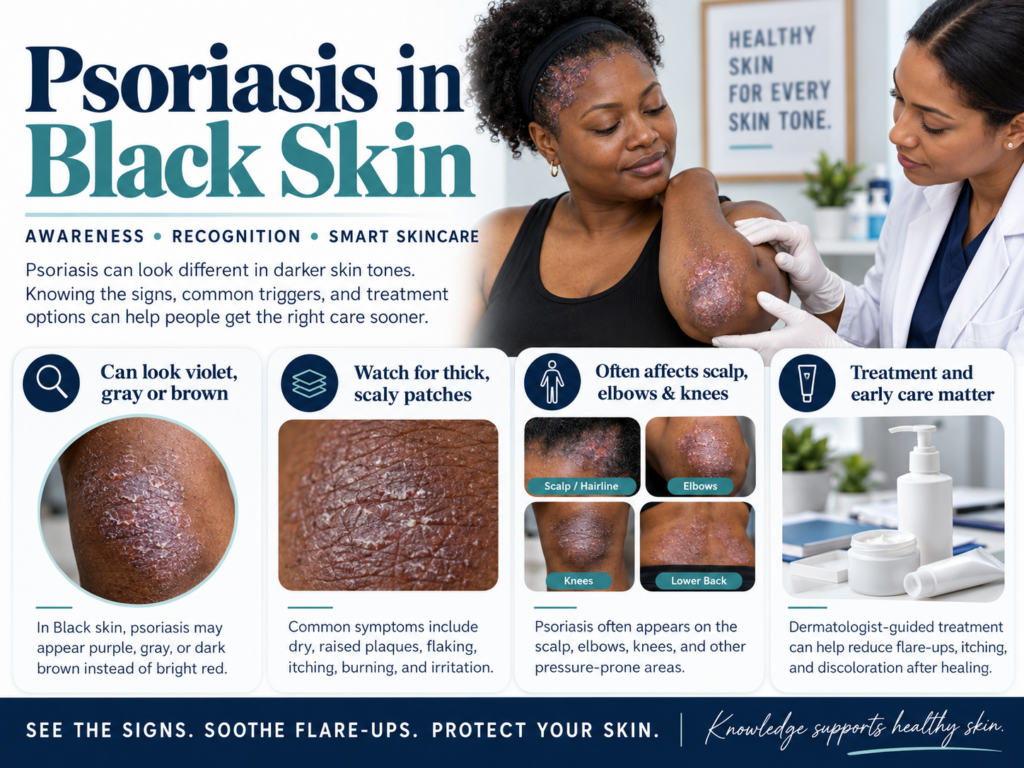
Psoriasis in Black skin often looks different from the textbook images most people have seen. Instead of bright red plaques with silvery scales, it can appear purple, dusky, gray, or brown. Because the classic signs are harder to see, psoriasis in Black skin is sometimes missed or mistaken for another condition. Knowing what to look for can help you get the right diagnosis sooner.
How Psoriasis in Black Skin Presents
Psoriasis is an immune-driven condition that speeds up skin cell turnover, leading to thick, raised plaques. On lighter skin, the inflammation shows up as red patches. On darker skin, the same inflammation can look violet, dark brown, or ashy gray. The scale can also be less obvious, so a plaque may look smooth or shiny rather than flaky. Dermatologists who treat skin of color learn to look for the shape, border, and location of a patch, not only its color.
Common Areas Where Psoriasis Shows Up
Psoriasis often appears on the elbows, knees, lower back, and scalp, but it can also affect the hairline, the skin behind the ears, and the nails. Scalp psoriasis is frequently confused with seborrheic dermatitis, and a dermatologist can help tell them apart. If you are unsure which condition you have, our article on scalp psoriasis vs seborrheic dermatitis explains the key differences.
Post-Inflammatory Changes After Psoriasis
Psoriasis flares can leave dark marks behind even after the plaques have cleared. This post-inflammatory hyperpigmentation can last for months and is one reason people with psoriasis in Black skin often feel their skin never fully recovers. Controlling inflammation early may help limit how long these marks last, so it is worth raising a flare with a dermatologist rather than waiting for it to settle on its own.
Signs Psoriasis May Be Missed on Darker Skin
- Thick, raised patches that look purple, gray, or dark brown
- Patches that are smooth or shiny instead of flaky
- Scalp plaques that spread past the hairline or behind the ears
- Nail changes such as small pits, thickening, or separation from the nail bed
- Itching, burning, or soreness in the same areas that are darkening
Why Psoriasis in Black Skin Can Be Harder to Diagnose
When the redness that clinicians often rely on is harder to see, a diagnosis can be delayed. Patients may be told they have eczema, fungal infection, or a dark spot that will fade on its own. A careful exam of the plaque’s border, the scalp, and the nails, along with a full history, usually gives a clearer picture. Ask your dermatologist to examine all the areas where you have symptoms, not only the most visible patch.
Treatment Options for Psoriasis in Black Skin
Treatment depends on how much of the body is affected, how severe the plaques are, and how they affect daily life. Options include topical treatments, light therapy, and systemic medications. For a full overview of medical options, see our psoriasis treatment page. This article focuses on recognizing psoriasis in Black skin, not on choosing a specific treatment. Your dermatologist can match treatment to your skin and your symptoms.
When to See a Dermatologist
See a dermatologist if you have thick, scaly, or discolored patches that persist for more than a few weeks, if scalp or nail symptoms are not improving, or if the skin is itchy, painful, or cracking. Early evaluation can prevent long-lasting dark marks and reduce the impact on daily life. Decatur patients can call (404) 495-3898 to schedule an evaluation.
The National Psoriasis Foundation offers general information on psoriasis and its treatment.
Frequently Asked Questions About Psoriasis in Black Skin
Does psoriasis look different on Black skin?
Yes. Psoriasis often appears purple, dusky, gray, or brown rather than red, and scaling can be harder to see. The shape and location of the patches are often the most useful clues.
Can psoriasis leave dark marks?
Yes. Flares can leave post-inflammatory hyperpigmentation that lasts after the plaques clear, so early treatment of inflammation is important.
Is psoriasis the same as eczema?
No, although the two can look similar on darker skin. Psoriasis plaques are usually thicker and more sharply defined, and they often appear on the elbows, knees, scalp, or nails. A dermatologist can confirm which condition you have. Our article on eczema on Black and Brown skin covers that condition in more detail.
Where to Find Us
World’s Famous Dermatologist is a Black-owned dermatology practice with two locations, and our providers evaluate psoriasis in Black skin at both. Our Decatur office is at 5040 Snapfinger Woods Dr #206, Decatur, GA 30035, and you can reach it at (404) 495-3898. Our Stockbridge office is at 1101 Hospital Dr #200, Stockbridge, GA 30281, and you can reach it at (678) 203-0666.
This article is general education and does not replace an in-person skin exam. If you have patches that concern you, schedule an evaluation with a dermatologist.