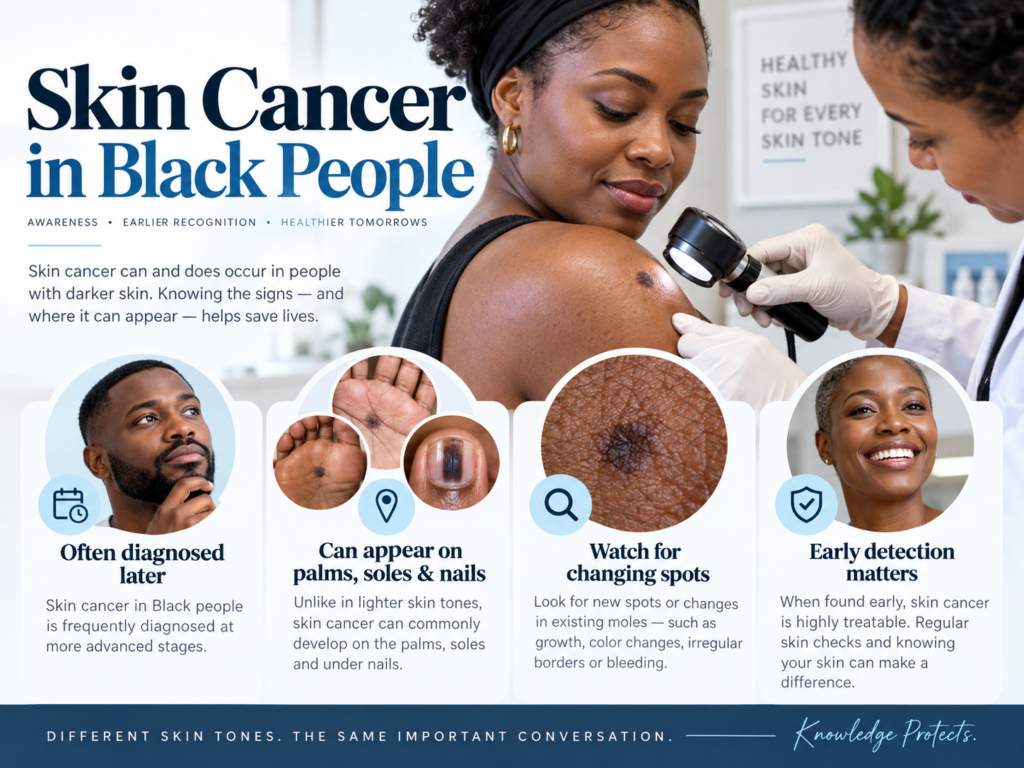
Skin cancer in Black people is less common than in white people, but it is more often found late, when treatment is harder. Many cancers in darker skin develop on the palms, soles, and under the nails, places many people never check. Here is what to look for and when to be seen.
Skin Cancer in Black People: Why It Is Often Missed
Darker skin has more natural protection from ultraviolet (UV) light, but it does not prevent skin cancer. Several factors contribute to late diagnosis. Many people believe they are not at risk, so they do not check their skin. Skin cancers often appear in areas that get little sun, where they are easy to overlook. Signs that stand out on lighter skin, such as redness, can be harder to see on darker skin.
The American Academy of Dermatology recommends that everyone check the whole body, including areas that are not sun-exposed, and that any new or changing spot be examined by a clinician.
Common Types of Skin Cancer in Black People
Melanoma is the cancer most people worry about, and it is the one that most needs early detection.
Acral Melanoma
Acral melanoma is the most common type of melanoma in people with darker skin. It forms on the palms, soles of the feet, and nail beds. It can look like a dark brown or black spot, a streak under a nail, or a flat patch that is slightly different from the skin around it.
Squamous Cell Carcinoma
Squamous cell carcinoma can appear on sun-exposed skin, but it also develops in areas of long-term irritation, such as chronic ulcers, burn scars, or old wounds. A sore that keeps returning or never fully heals should be examined.
Basal Cell Carcinoma
Basal cell carcinoma is less common in Black patients than in lighter-skinned patients, but it does occur. It often appears as a firm, shiny bump or a sore that does not heal.
Warning Signs of Skin Cancer in Black People
Check your skin, including the areas below, about once a month:
- A new dark spot, bump, or patch on the palms, soles, fingers, or toes
- A dark spot or patch that grows, changes shape, or develops uneven color
- A dark streak under a nail that is wider than about 3 millimeters, changes over time, or extends into the skin around the nail
- A sore, bump, or ulcer that does not heal within about four weeks
- A growth or change inside an old scar, burn, or wound
- A spot that bleeds, crusts, or itches without a clear cause
A dark streak under a nail is common in people with darker skin and is often harmless. Still, a streak that is changing, widening, or affecting only one nail should be checked by a dermatologist. Do not try to remove or treat it yourself.
Why the ABCDE Rule Is Not Enough
Many people learn the ABCDE rule for moles: asymmetry, border, color, diameter, and evolving. For skin cancer in Black people, that rule was developed largely from studies of lighter skin and works less well for acral melanoma, which can be irregular, flat, and uneven in color on the palms and soles. Focus on change. A spot that is new, growing, or different from the others deserves attention, even if it does not match every letter. Color alone is not a reliable guide, since a dark spot can be benign and a lighter or pinkish one can be cancerous.
How to Protect Your Skin
- Use a broad-spectrum sunscreen with SPF 30 or higher on exposed skin every day, and reapply when you are outdoors. Sun protection still matters for skin cancer in Black people, even though the risk is lower.
- Check your palms, soles, nails, and scars once a month, using a mirror when needed.
- Ask a family member to check areas you cannot see, such as the bottoms of your feet.
- Take dated photos of any spot you are watching, so changes are easier to notice.
When to See a Dermatologist
Any of the signs above can be an early warning of skin cancer in Black people, so do not wait for a spot to become painful. See a dermatologist if you notice a new or changing spot on your palms, soles, or nails; a dark streak under a nail that is widening or changing; a sore that has not healed in about four weeks; or a spot that bleeds without injury. A dermatologist can examine the spot with magnification and take a biopsy if needed. A biopsy is the only way to confirm a skin cancer diagnosis.
Frequently Asked Questions About Skin Cancer in Black People
Can Black people get skin cancer?
Yes. Skin cancer in Black people is less common than in white people, but it does happen, and it is often found at a later stage.
Where does skin cancer usually show up in Black people?
Often on the palms, soles, and nail beds, and in scars or chronic wounds. These areas get little sun exposure, which is why they are easy to overlook.
Does sunscreen matter if my skin is dark?
Yes. Darker skin has more natural protection, but UV exposure can still cause skin cancer. Daily sunscreen on exposed skin is a sensible habit for everyone.
Do I need a biopsy for a dark spot?
A dermatologist decides this after examining the spot. If a biopsy is recommended, it is the only way to know what the spot is.
This article is general education and does not replace an in-person skin exam. If you have a spot that concerns you, World’s Famous Dermatologist in Decatur can evaluate it. Call (404) 495-3898 to schedule.